
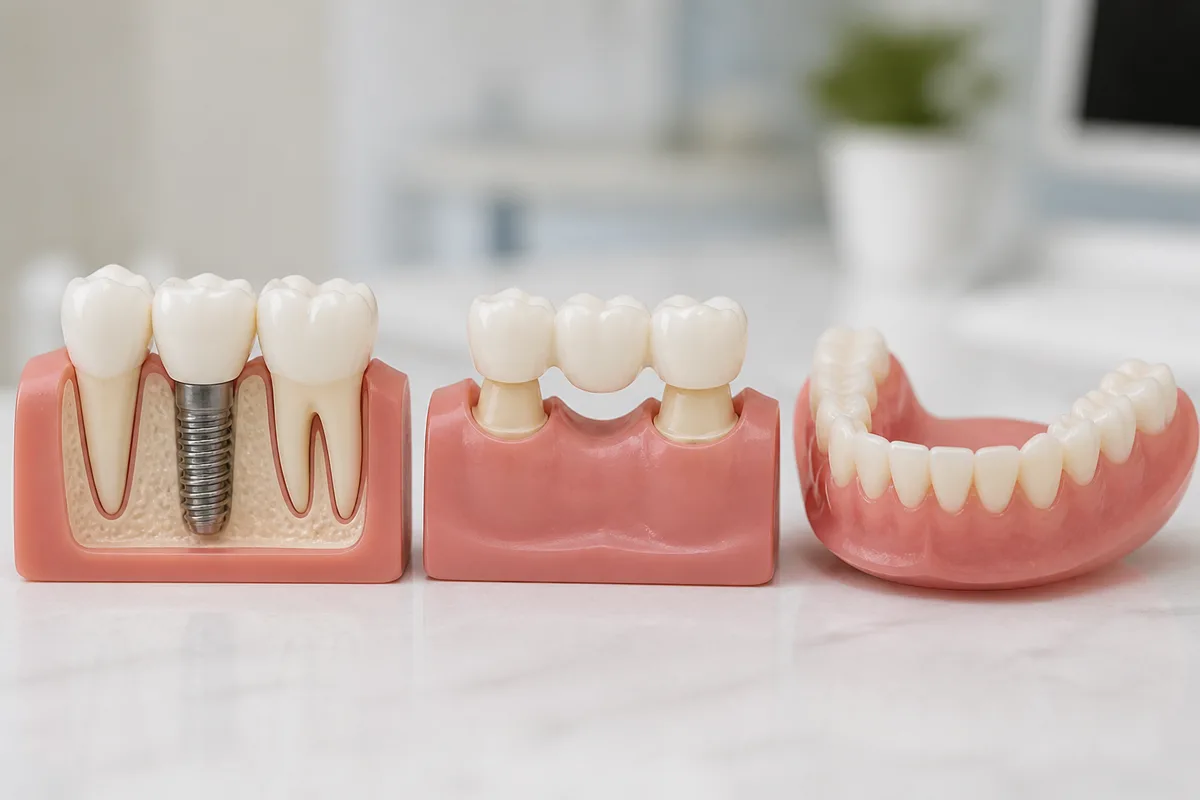
We place implants for a living, so it would be easy to say the implant always wins. It usually does, but not always, and the reasons matter more than the recommendation. Here is how the three options actually compare.
Dental implant
A titanium post replaces the root, integrates with the bone over a few months, and carries a crown that stands on its own. It is the only option that preserves the bone in the gap: bone maintains itself in response to the load of chewing, and an implant restores that load. Neighbouring teeth are untouched, and you clean it like a natural tooth. Long-term survival is high — commonly quoted at over 95% at ten years — and if a crown wears out it can be replaced without redoing the implant.
The trade-offs are real: it takes months rather than weeks, it needs enough bone (or a graft to build it), it costs more up front, and it requires surgery. Smoking, uncontrolled diabetes, and untreated gum disease all reduce the odds and are addressed first.
Fixed bridge
A bridge spans the gap by crowning the teeth on either side and suspending a replacement tooth between them. It is fixed in place, it looks good, and it is finished in a few weeks. That speed is its main advantage.
The cost is that two healthy teeth get prepared down — irreversibly — to hold it, and those teeth now carry the load of three. The bone under the span still resorbs because nothing is stimulating it, so the tissue underneath can hollow out over time. Cleaning under the span requires a floss threader or water flosser every day, and decay at the margins of the supporting teeth is the usual reason a bridge eventually fails. Typical service life is around ten to fifteen years. A bridge makes real sense when the neighbouring teeth already need crowns anyway, when bone volume is inadequate and grafting is not wanted, or when you need to be finished quickly.
Removable denture or partial
A partial or full denture is the least invasive and least expensive option, replaces many teeth at once, and can be delivered relatively quickly. For some situations it is exactly right.
It is also the option patients complain about most. It rests on gum tissue, so chewing efficiency is a fraction of natural teeth, it moves, it can create sore spots, it comes out for cleaning, and clasps on a partial can loosen the teeth they grip. Bone resorption continues underneath, which is why dentures need relines and eventually stop fitting. An excellent middle path is an implant-supported overdenture — two to four implants that a denture snaps onto, giving most of the stability of fixed teeth at a fraction of the cost of replacing each tooth.
How to choose
- How many teeth are missing, and where in the arch
- Bone volume and quality at the site, seen on a 3D scan
- The condition of the neighbouring teeth — do they need crowns regardless?
- Gum health, smoking, and medical conditions that affect healing
- Your timeline and your budget, over the next decade rather than this month
Dr. Chandrasekaran will lay out all three for your specific situation, including what she would not recommend and why. Call 720-676-1231 to talk it through.