
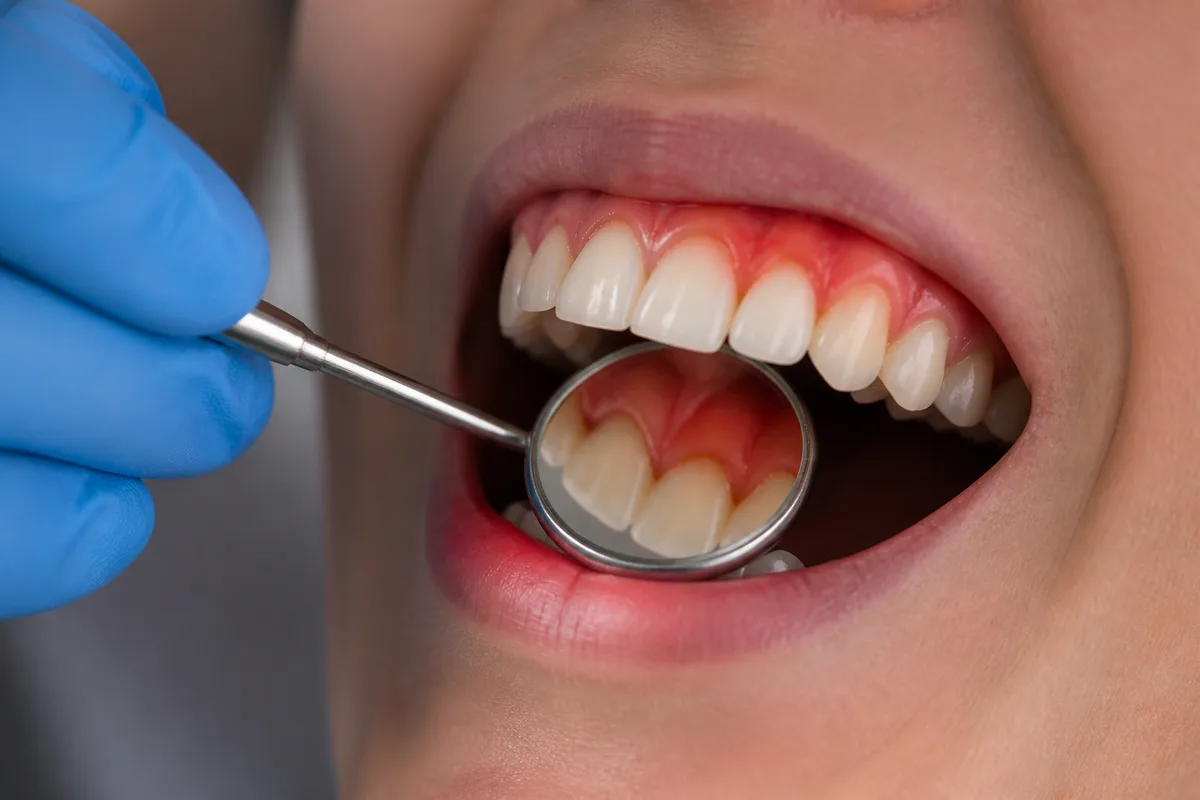
Almost every week someone tells us they see a little pink in the sink and assume they have been brushing too hard. It is one of the most common misunderstandings in dentistry, and it costs people years of gum health. Healthy gum tissue does not bleed when you brush or floss, any more than healthy skin bleeds when you wash your hands. Bleeding is inflammation, and inflammation means your body is reacting to a bacterial infection at the gum line.
What the bleeding is actually telling you
Plaque bacteria collect in the shallow crevice where the gum meets the tooth. Within a day or two they organize into a sticky film. If that film is not disrupted, your immune system responds by flooding the area with blood flow and inflammatory cells. The tissue swells, the capillaries sit closer to the surface, and the lightest touch makes them break. That is gingivitis — the first and most reversible stage of gum disease.
Left alone, plaque hardens into calculus (tartar) that a toothbrush cannot remove, and the inflammation moves deeper. The fibres and bone that anchor the tooth begin to break down, the crevice deepens into a pocket, and gingivitis becomes periodontitis. The difference matters: gingivitis reverses completely, while the bone lost to periodontitis does not grow back on its own.
Reasons other than plaque
- Hormonal shifts during pregnancy or the menstrual cycle, which exaggerate the gum response to the same amount of plaque
- Blood thinners, aspirin, and some supplements
- Diabetes that is not well controlled, which amplifies the inflammatory response
- Smoking or vaping, which can actually mask bleeding by constricting blood vessels, so disease advances quietly
- Starting to floss after a long gap — this bleeding should settle within one to two weeks
What to do about it
Do not brush less. Brush gently but thoroughly twice a day with a soft-bristled or electric brush angled toward the gum line, and clean between the teeth daily with floss, picks, or a water flosser. If the bleeding has not stopped after two weeks of consistent care, that is your signal to be evaluated rather than to keep waiting.
At an evaluation we measure pocket depths around every tooth, check for recession and looseness, and take X-rays to see the bone level. Those numbers tell us whether you need a routine cleaning, a deeper scaling and root planing, or periodontal treatment. Most people who come in early need far less than they feared.
Come in before it stops bleeding on its own
Bleeding gums are one of the few dental warning signs you can see for yourself, and they show up long before pain does. If you have noticed pink in the sink, call Perio Bright Dental Implant Center at 720-676-1231 and Dr. Chandrasekaran will tell you exactly where your gums stand.