
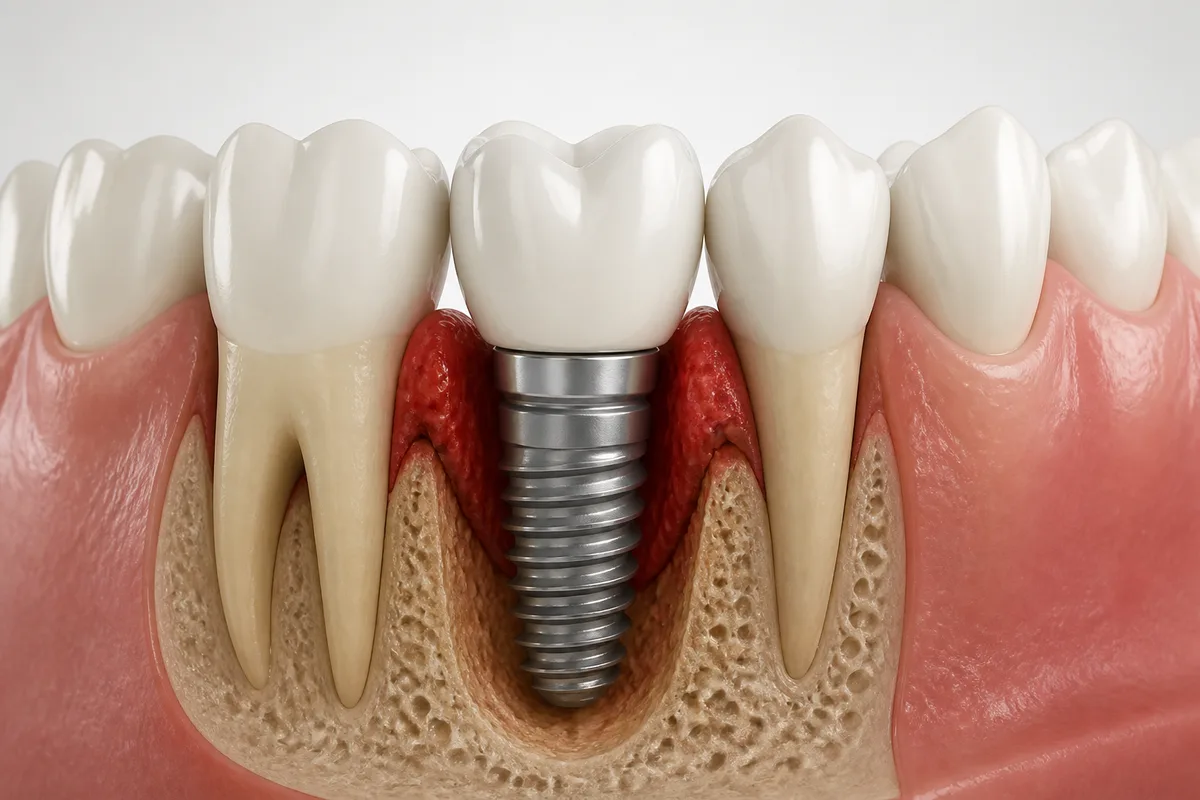
Dental implants have one of the highest success rates in medicine, but they are not immune to problems. When an implant does fail, it is rarely mysterious — the causes fall into a short list, and most of them announce themselves long before the implant is lost.
Early failure: the implant never integrates
In the first weeks to months, the risk is that bone never bonds to the implant surface. Causes include overheating the bone during placement, inadequate initial stability in soft bone, infection at the site, loading the implant too soon, and heavy smoking, which impairs blood supply to healing bone. Poorly controlled diabetes and some medications also slow the process. Early failures are uncommon, usually obvious, and generally fixable — the site is allowed to heal, grafted if needed, and a new implant is placed with a good prognosis.
Late failure: peri-implantitis
The more common story is an implant that worked well for years and then begins to lose the bone around it. That is peri-implantitis: a bacterial inflammation of the tissues around an implant, with progressive bone loss.
It starts as peri-implant mucositis — bleeding and redness of the gum around the implant with the bone still intact. At that stage it is reversible with thorough cleaning and better home care. Once bone is lost, it does not come back on its own, so the difference between catching it at mucositis and catching it at peri-implantitis is substantial.
What raises the risk
- A history of periodontitis — the strongest single predictor
- Smoking and vaping
- Cement left below the gum line when the crown was seated
- A crown contour or position that makes the implant impossible to clean properly
- Skipping maintenance visits, or being seen on a six-month interval when the risk profile calls for three or four months
- Uncontrolled diabetes
- Heavy grinding, or too few implants carrying too much load
How it is treated
Treatment is staged. Non-surgical care first: removing deposits with instruments that will not scratch the implant surface, decontaminating the surface — often with a laser or air-polishing — irrigating the site, removing any residual cement, and correcting whatever made the area uncleanable, including modifying or remaking the crown. Home care and the maintenance interval are reset.
If bone loss continues, surgical access is needed. The tissue is opened so the implant surface can be thoroughly decontaminated under direct vision. Depending on the shape of the defect, the site is either regenerated with bone grafting material and a membrane, or reshaped so the area becomes cleanable and stable. Implants with extensive loss or that have become mobile are removed, the site is grafted, and replacement is planned once it heals.
The early signs to act on
Bleeding when you brush around an implant, gum that looks red or puffy, a bad taste, a crown that suddenly looks longer, or anything that feels loose. Implants do not ache the way teeth do, so pain is a late signal — do not wait for it.
If you have an implant that is not behaving, whoever placed it, Dr. Chandrasekaran can evaluate it. Call Perio Bright Dental Implant Center at 720-676-1231.